We asked B.l.LL the best way to allocate a B2B marketing budget in 2026.
B.I.LL is an AI assistant, created by DSE, that can reliably answer questions on B2B marketing. It gets its information from 56 research papers, all verified by an expert human.
It doesn’t pretend to know, or make up statistics; every single recommendation comes with a link to where it can be found in one or more of the confirmed pieces of research. You can read more about B.I.LL in our recent LinkedIn article.
A practical guide to strategic, cross-channel marketing
As you plan your marketing strategy for 2026, you’re probably thinking about where to invest your budget for the best return. It’s a fair question and it’s one we’ve been helping clients answer for over 30 years.
The marketing landscape has shifted significantly and research tells us that B2B buyers now interact with around 10 different channels before making a decision*. We also know that while Social media platforms and AI-generated content evolves constantly, building genuine trust has become more challenging than ever.
The good news? There’s a strategic approach that works and we can help you.
Your clients and customers need to see you in multiple places before they commit.
We often see businesses put most of their budget into a single channel. Social media because it’s cost-effective. Their website because buyers always check it before they engage. Events because face-to-face interactions build relationships.
These aren’t wrong choices. The challenge is that property and placemaking deals are complex, and stakeholders need to see you in multiple places before they’re ready to commit.
The research backs this up, while 34% of people say they discover brands through social media*, less than 2 in 10 would use social media alone to make a business decision*. Your website matters enormously (97% of B2B buyers check it before deciding*), but it’s just one part of a longer journey.
In our experience, the most effective marketing happens when channels work together, each playing to its strengths at different stages of the buyer journey.
If you know where you’re losing people, you can choose the right channels to address it.
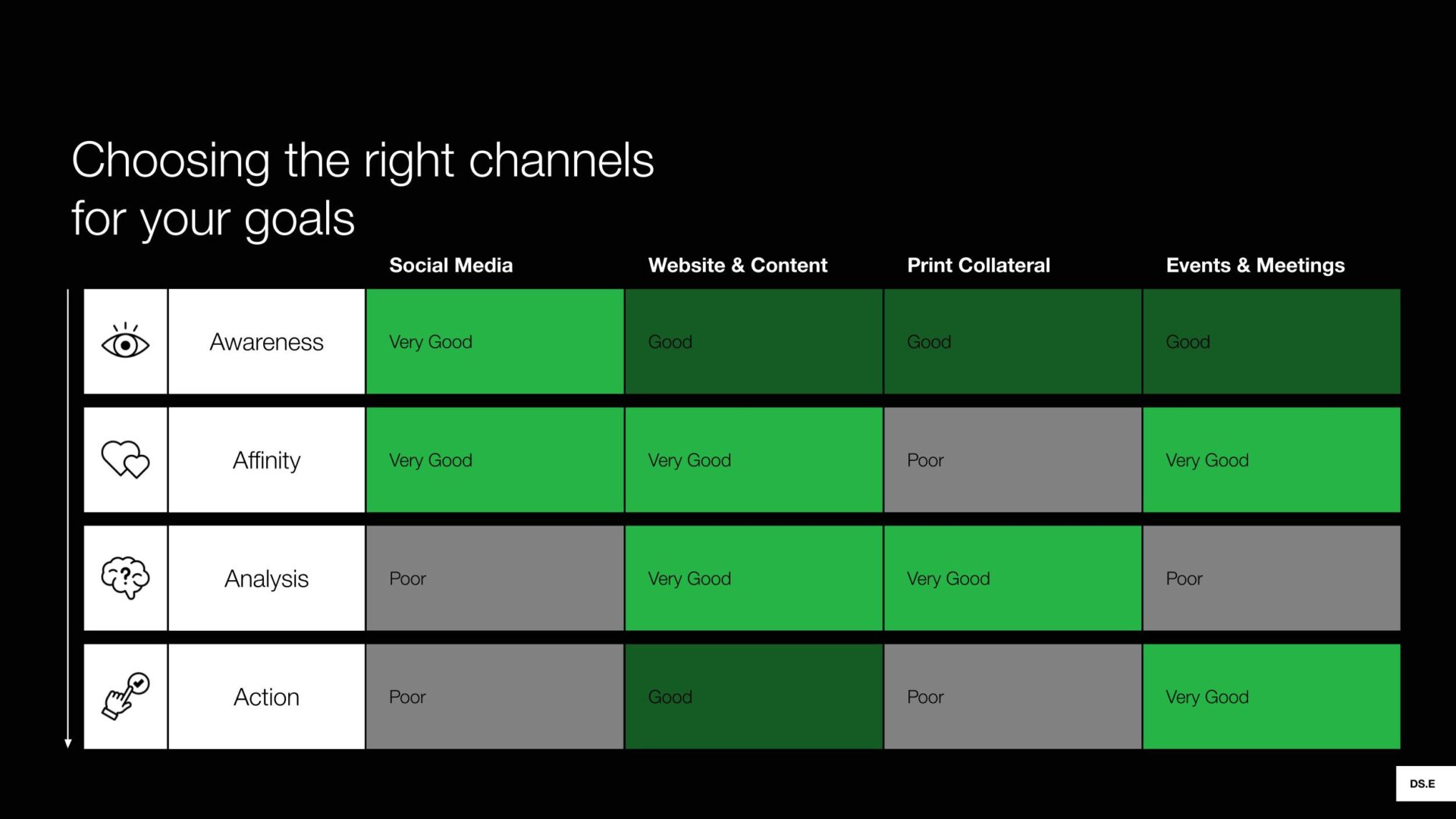
Before allocating budget, it helps to understand where potential clients are in their journey with you. We typically see four stages:
Awareness: Our audience now knows our brand exists and has a general idea of what we offer them.
Affinity: An initial emotional connection is formed. They instinctively like our brand and feel compelled to explore us further.
Analysis: The customer now uses logic, researching our offer’s credibility, viability and fit for their business needs.
Action: We’ve convinced them. They are now rationally and emotionally ready to commit and start the purchase or Instruction process.
Often, businesses invest heavily in the wrong stage. For example, you might be focused on generating more awareness when actually, people are dropping off during the analysis phase because they can’t find enough evidence of your expertise.
To figure out what stage needs your attention most, start by looking at your metrics:
- Reach (impressions, website visits) – Are people finding you?
- Engagement (likes, shares, newsletter subscriptions) – Are they interested?
- Duration and downloads (time on site, return visits, content downloads) – Are they learning about you?
- Leads (enquiries, form fills, calls) – Are they ready to talk?
Once you know where you’re losing people, you can choose the right channels to address it.
How Different Channels Work
Each marketing channel has particular strengths. Here’s what we’ve learned over three decades of property and placemaking campaigns:
Social Media & Email
Strengths: Awareness and Affinity
Social media is excellent for reach and building initial connections. It’s cost-effective, allows for creative storytelling, and helps people discover your brand.
The limitation is depth. It doesn’t provide the detailed information B2B buyers need for analysis. Your content and audience also don’t belong to you (we’ve seen platforms lose significant users quite quickly).
Best used for: Getting on people’s radar and building initial interest.
Website & Content
Strengths: Affinity, Analysis, and Action
Your website remains central to your marketing. Despite the growth of AI searches, 92% of search journeys still begin on Google*. It’s where 97% of B2B buyers go to check you out*. Over half of B2B revenue comes through website traffic*. 61% of buyers prefer to do all their research online before making a purchasing decision*.
It’s also the only channel where you can attract people (through search), engage them (with detailed content), demonstrate your expertise, and make it easy for them to get in touch.
Best used for: Demonstrating credibility and giving people the information they need to choose you.
Print Collateral
Strengths: Analysis and Building Trust
This might surprise you, but print matters more now than it did a few years ago. With so much AI-generated content online, 71% of people struggle to trust what they see digitally*. In contrast, they trust things they can touch 24% more*.
Well-designed print collateral signals that you’re serious, established, and invested in quality. It creates tangibility in an increasingly ephemeral digital world.
Best used for: Building trust during the evaluation phase, particularly with high-value prospects.
Events & Meetings
Strengths: Affinity and Action
Nothing replaces face-to-face conversation for building relationships and demonstrating complex services. 78% of event organisers identify in-person events as their most impactful marketing channel*.
The challenge is resource intensity and cost. Events work brilliantly for the right opportunities, but they need to be used strategically.
Best used for: Deepening relationships with qualified prospects and demonstrating your expertise to decision-makers.
Digital Advertising
Strengths: Targeted Awareness and Driving Traffic
Digital advertising (Google Ads, LinkedIn Ads, display campaigns) gives you precise control over who sees your message. You can target by job title, company size, location, search intent, and behaviour. This makes it particularly effective for reaching decision-makers in property development, councils, and investment firms.
Digital advertising is great for immediacy and measurability. You can start driving relevant traffic to your website quickly, and you can see exactly what’s working.
The limitation is cost and sustainability. Digital advertising requires ongoing investment. The moment you stop paying, the traffic stops. It also works best as part of a broader strategy rather than as a standalone solution.
Best used for: Reaching specific audiences quickly, promoting time-sensitive opportunities, and driving qualified traffic to specific content.
A Practical Budget Allocation Guide
Based on years of campaign data and channel performance analysis, we typically recommend this starting allocation:
40% – Website & Content
This is your foundation. It impacts all stages of the buyer journey and works 24/7 to attract, inform, and convert.
30% – Social Media & Email
Cost-effective for reach and engagement. Keeps you visible and builds familiarity over time.
15% – Print Collateral
Builds trust when it matters most, during the evaluation phase.
15% – Events & Meetings
Strategic, high-impact relationship building.
This isn’t a rigid formula. Your specific allocation should depend on where you’re currently strong and where you need to improve. It’s a solid starting point that balances reach, engagement, credibility, and conversion.
The Power of Campaign Thinking
With buyers touching 10+ channels during their journey, consistency becomes critical. When someone sees you on LinkedIn, visits your website, picks up your brochure at an event and receives your email, they should experience a coherent brand story.
That’s why we focus on campaigns rather than isolated pieces of content. A strong central idea can be adapted across every channel, creating a conversation that builds momentum as people encounter you in different contexts.
This isn’t just about aesthetics. It’s about recall, trust and making it easy for people to understand who you are and what you offer, wherever they find you.
We can help you plan your 2026 Strategy
Property and placemaking marketing requires both strategic thinking and practical execution. You need to understand which channels work for your specific objectives, how to allocate budget effectively, and how to create campaigns that work cohesively across multiple touchpoints.
After 30 years of doing this work, we’ve developed a clear process: research and discovery, strategic planning, creative development, and coordinated rollout. We don’t just recommend what to do—we work alongside you to make it happen.
If you’re planning your 2026 marketing strategy and want a conversation about where to invest for the strongest return, we’d be happy to talk. No obligation, just a practical discussion about your objectives and the most effective ways to achieve them.
Email info@dsemotion.com to arrange a chat.
In Summary:
- Effective property marketing requires a balanced, cross-channel approach
- Different channels work best at different stages of the buyer journey
- Strategic budget allocation typically follows: 40% Website, 30% Social, 15% Print, 15% Events
- Campaign consistency across channels builds trust and recall
- Professional strategy and execution maximizes return on investment
Want to discuss your 2026 marketing plans? Get in touch: info@dsemotion.com